Rosehip oil suits your face mostly because of what it is made of: a cold pressed seed oil that is mostly polyunsaturated fat, with natural vitamin E, plant sterols and the carotenoids that give it an amber colour. It is a lovely face oil. It is not a retinol, and it spoils faster than most oils, which changes how you should buy and store it.
Rosehip seed oil is the second ingredient in our Organic Face Food, right after sunflower seed oil. You will often see it called nature's retinol. Here is what the research says, and what it does not.
What is rosehip seed oil, exactly?
Rose hips are the round fruit a wild rose leaves behind after the petals drop. Inside each hip are small hard seeds, and pressing those seeds gives you rosehip seed oil. Most of it comes from two wild species, Rosa canina (dog rose) and Rosa rubiginosa, which is sold in Chile as rosa mosqueta.
The seeds are not very oily. A 2023 study of eleven wild rose populations in Iran found the seeds held between about 8 and 17 percent oil, depending on where the plants grew (Bakhtiar and colleagues, 2023).
What is in rosehip oil that matters for your face?
Fat, first of all. The same Iranian study found linoleic acid made up between roughly 35 and 50 percent of the oil, again depending on the population. Rosehip oil is also rich in alpha linolenic acid, the plant omega 3. Both are polyunsaturated fats, which give the oil its light, quick absorbing feel on skin.
Then there are the smaller compounds. A 2015 analysis of two cold pressed rosehip oils sold in Poland measured up to 1,124.7 mg of tocopherols (vitamin E), up to 6,485.4 mg of phytosterols and up to 107.7 mg of carotenoids per kilogram of oil (Grajzer and colleagues, 2015). Those carotenoids are why fresh rosehip oil is orange.
Be clear about what kind of evidence this is. These are chemistry studies done in a lab on the oil in a bottle. They tell you what is in rosehip oil. They do not tell you what any of it does once it is on your face, and the numbers swing a lot from one harvest to the next.
For what happens on skin, the best summary we know of is a 2017 review of topical plant oils that looked at nineteen oils, rose hip among them (Lin and colleagues, 2017). Most of what it gathers for rosehip comes from lab and animal work rather than controlled trials on human faces. Nobody has shown that a rosehip face oil makes skin age more slowly, and we will not tell you it does.
Does rosehip oil contain retinol or vitamin A?
This is the claim we hear most, and it is the one we disagree with. When we searched PubMed for studies on rosehip oil and retinoic acid, we found none. The composition studies we did find measure fatty acids, tocopherols, sterols and carotenoids. They do not report retinol or retinoic acid.
Carotenoids are the orange pigments that also colour carrots and pumpkins. They are related to vitamin A, but they are not retinol and they are not tretinoin. Our position is simple: if you want a retinoid, buy a retinoid. Buy rosehip oil because you like how it feels.
Why does rosehip oil go off so quickly?
The same polyunsaturated fats that make it feel light are the ones that react most easily with air and light. In a 2016 lab study, Brazilian researchers exposed rosehip oil to UVA and UVC light and measured how much it oxidized; packing the oil into tiny capsules slowed that down (Contri and colleagues, 2016). That was a formulation experiment in glassware, not a skin study.
Fresh rosehip oil smells faintly earthy, a little like dry leaves. Oxidized rosehip oil smells sharp, like old crayons or oil paint. If yours smells like that, put it in the bin rather than on your face.
Why is rosehip oil second in our face oil and not first?
Because a face oil that is mostly rosehip would be the least stable bottle on your shelf. Angele built the Face Food formula at her kitchen counter, documenting her formulas in a notebook she called Super Great Ideas, and she landed on this order: sunflower seed oil, rosehip seed oil, jojoba seed oil, cranberry seed oil, calendula flower oil, vitamin E, shiitake extract and reishi extract. All of it is organic except the vitamin E and, in the Rose Geranium version, the rose geranium flower oil.
Sunflower carries the blend. Jojoba is technically a liquid wax, so it holds up well over time. Vitamin E is there partly for the oil itself, to help it keep. Rosehip brings the colour and that light finish. If you want to know why the mushrooms are in there too, we wrote a whole post on what reishi and shiitake actually do in skincare.
To date we have sold 1,048 bottles of the Rose Geranium blend and 869 of the Unscented. Every one of them was made here in Victoria, first at that kitchen counter and now in our own 1,500 square foot commercial space.
Can rosehip oil cause a reaction?
It can, though it seems uncommon. In 2018, dermatologists in Spain published a short case report describing a person who had an allergic reaction on the skin after using rosa mosqueta oil (Ochando Ibernón and colleagues, 2018). One case report tells you a reaction is possible. It tells you nothing about how often it happens.
Before you use a new oil all over your face, put a drop on your inner arm or just under your jaw for a couple of days. If your skin looks or feels unhappy, stop.
How do you use a face oil with rosehip in it?
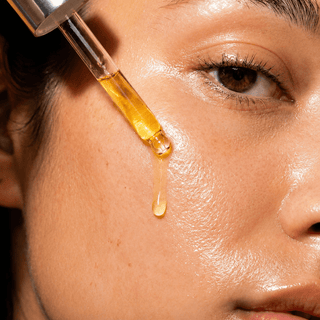
Most people meet rosehip in a blend rather than in a bottle on its own, and that is how we use it too. The routine is the same either way. Three or four drops is plenty for a whole face. Press them into skin that is still a little damp after cleansing, at night, in the morning, or both. If you also use a moisturizer, the oil usually goes on last. We explain the layering in face oil vs. moisturizer.
Rosehip is the fragile part of any blend, so treat the bottle the way you would treat the pure oil: cap on, out of the sun and away from the shower. A 20 ml bottle of Face Food lasts most people two to three months and a 40 ml bottle four to five, so it gets used up rather than sitting open on a shelf for a year. We do the full math in how long a bottle of face oil lasts.
How rosehip ended up in a bottle with two mushrooms is our story.
Frequently asked questions
Can you use rosehip oil on your face every day?
Yes. Most people who like it use a few drops once or twice a day. Patch test first and stop if your skin does not like it.
Does rosehip oil have retinol in it?
We could not find a study that measured retinol or retinoic acid in cold pressed rosehip seed oil. Its orange colour comes from carotenoids, which are not the same thing.
How do you know if rosehip oil has gone bad?
Fresh rosehip oil smells faintly earthy. If it smells sharp, like crayons or oil paint, it has oxidized and it is time to replace it.
Should rosehip oil be kept in the fridge?
A cool, dark cupboard is enough for a bottle you will finish in a few months. The fridge can help a pure rosehip oil keep longer, especially in summer.