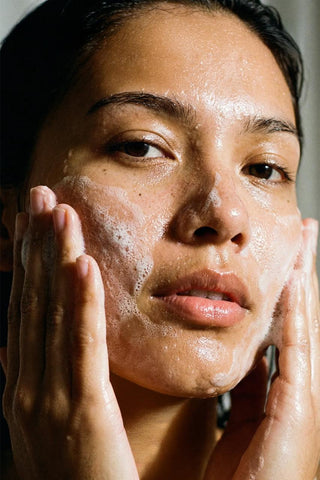
Winter skin on the west coast usually feels dry because the dry air is inside your home, not outside it. Cold, wet November air holds very little water, and once your furnace or baseboard heater warms it, the relative humidity indoors can fall to around a third. Add long hot showers and your face feels tight even in a week of rain.
We make our face oil in Victoria, so this is the weather we live in. Our very first sale was at a Victoria health show in January 2024, in the middle of exactly this kind of grey, damp stretch. Here is what the research does and does not say.
Why does my skin feel dry in winter when it rains so much?
Because rain outside does not mean moisture inside. November is usually the wettest month here, with about 16 days of rain on average according to long term weather averages for Victoria. Outdoor relative humidity often sits near 90 percent. That number sounds like good news for skin, but relative humidity is only relative to the temperature of the air.
Cold air simply cannot hold much water. Take air at 5°C and 90 percent humidity, bring it inside and warm it to 21°C, and the same amount of water now only fills about 30 percent of what the warmer air could hold. Nothing was taken out. The air just got warmer and thirstier, and some of the water it wants comes from the outer layer of your skin.
This is the position we would defend over a cup of tea: on the west coast, winter dryness is mostly an indoor problem. The rain is not the enemy. The thermostat and the shower are.
What does indoor heating do to your skin?
A 2016 review by Goad and Gawkrodger gathered the research on air humidity and skin. It found that people in dry, climate controlled indoor air report more dry skin, and that human studies link low humidity with rougher texture, lower elasticity and changes in how much water the outer layer of skin holds (Goad and Gawkrodger, 2016). This is a literature review, not a trial, and the authors are clear that the evidence is limited and sometimes contradicts itself.
A 2023 split face study from Korea looked at healthy women who spent at least six hours a day in a heated room during winter. After six hours, facial roughness and fine lines measured higher than before, and the side of the face that got a cream measured better than the side that did not (Park and colleagues, 2023). It was run by a skincare company lab and tested one ceramide cream, so it tells you heated rooms change how skin measures over a day. It does not tell you which product is best.
Does hot water dry out your face?
Yes, and on a cold morning it is the easiest habit to slip into. A 2022 study of 50 healthy volunteers in Granada measured water loss through the skin before and after their hands were held in hot or cold water. After hot water, the reading more than doubled, from 25.75 to 58.58 grams per square metre per hour. Cold water raised it too, but far less, to 34.96 (Herrero Fernandez and colleagues, 2022).
That study was on hands, not faces, and it measured what happens right after soaking, not over a whole winter. Still, the direction is clear: wash your face with lukewarm water and keep the hot shower off it.
Does skin really change between summer and winter?
It does, though less neatly than skincare marketing suggests. A Czech team measured the forehead and cheek of the same group of women through a full year. They confirmed what many earlier studies found: skin held the least water and produced the least oil in winter (Dolečková and colleagues, 2021). They also wrote that seasonal data across studies is still highly inconsistent, and that study looked at women in Central Europe, whose winters are colder and drier than ours.
Do you need a heavier moisturizer in winter?
Not always. Heavier is not the same as better. What dry winter skin usually needs is less water lost, and the simplest way to get that is to put an oil over skin that is still a little damp. We wrote about this in more detail in Face Oil vs. Moisturizer: Do You Actually Need Both?
If you already love your cream, keep it and press a few drops of oil over it at night. If you have never liked the feel of a thick cream, a face oil on damp skin may be all you need. A plain, simple cream works well for a lot of people, and we are happy to say so.
Customers who live with much drier winters than ours say the same. Dallas wrote in a review of our Rose Geranium oil: “The dry Alberta winters are so harsh on my already dry skin, but the Face Food serum has helped keep me moisturized and glowing.” Alberta air is dry inside and out. Ours is wet outside and dry inside. The fix for the indoor part is much the same.
What does a simple west coast winter routine look like?
Here is roughly what we do from October to March:
- Wash with lukewarm water, never hot. If you use a powder cleanser, wet your hands with lukewarm water first. We explain how in Powder Cleanser 101.
- Pat your face, but leave it a little damp.
- Press three or four drops of face oil into damp skin, then add a cream on top only if your skin still feels tight after a few minutes.
- Keep the shower short and aim the spray away from your face.
- Turn the bedroom heat down at night. A cooler room holds its humidity better, and a small humidifier helps if your home runs very dry.
Which oils suit a damp, cold climate?
Lighter seed oils sink in quickly, which matters when you are pulling on a rain jacket ten minutes later. Our Face Food blend starts with sunflower seed oil, rosehip seed oil and jojoba seed oil, then cranberry seed oil and calendula flower oil, with vitamin E, shiitake extract and reishi extract. If you want to know what is in rosehip and why it feels so light, read Rosehip Oil for Your Face: What Is Actually in It? And if you want to know who is making it, our story starts on a kitchen counter here in Victoria.
Frequently asked questions
Why is my skin dry in winter in Victoria if it rains so much?
Cold outdoor air holds very little water, so once your home heats it, indoor humidity can fall to around a third. Hot showers add to it.
Does hot water dry out your skin?
In a study of 50 healthy volunteers, hot water more than doubled water loss through the skin of the hands. Lukewarm water is the better choice for your face.
Should I use face oil on wet or dry skin in winter?
Use it on skin that is still a little damp. The oil sits over that water and slows how fast it leaves your skin.
Do I need a humidifier for winter skin?
Not always, but it helps in a home that runs very dry. Turning the heat down at night and keeping showers short often makes a bigger difference.
If your skin feels tight this winter, a few drops of Organic Face Food on damp skin is where we would start.