Does skin get drier with age? For women, a study of 7,743 people in 12 countries says the answer is mostly about oil, not water: after 40, skin surface oil (sebum) drops faster, while surface hydration barely changes. That one finding changes how we think about the shelf of hydrating products many of us start buying in our forties.
Does skin get drier with age?
It feels that way, and the feeling is real. What the numbers suggest is that the cause is not what most of us assume. In the study by Kwag and colleagues, published 22 October 2026 in the journal Cosmetics, researchers took standardized cheek measurements from 7,743 women aged 20 to 59 across 12 countries: 5,274 Asian women and 2,469 Western women (Kwag et al., 2026).
Three things stood out:
- Sebum fell with age, and the fall got significantly steeper from age 40 in both groups. The same pattern showed up at two other spots on the face.
- Sebum was 34.9% lower in Asian women and 25.4% lower in Western women at ages 50 to 59 than at ages 20 to 29.
- Surface hydration differed by less than 3.5% across those same ages, with no change in its slope at 40. Resting water loss through the skin, called TEWL, went down with age, not up.
Men in the study showed a different pattern, with no net sebum difference between those age groups. So this is a story about women in their forties and fifties.
What is sebum and what does it do for your face?
Sebum is the oil your skin makes on its own, in small glands that sit beside hair follicles. A review of skin surface lipids describes it as mostly triglycerides, wax esters and squalene, which together form a thin film over the skin (Pappas, 2009). It describes what sebum is made of; it tests no product.
When there is plenty of that film, skin tends to look a little glossy and feel supple. When there is less, many people notice their face feels tight after washing, looks flatter or duller by afternoon, and feels rougher under the fingertips.
A separate review of how sebaceous glands change over a lifetime found the same direction of travel: the number of glands stays about the same through life, but sebum levels tend to fall in women later in life, while men see few major changes until their seventies (Zouboulis and Boschnakow, 2001). It is a review of earlier studies, not new measurements.
Why does mature skin feel dry if it still holds water?
Because "dry" is a feeling, and two different things can cause it. One is a lack of water in the outer layer of skin. The other is a lack of oil on top of it.
The Kwag data point to the second one for women after 40. Hydration readings held steady, and resting water loss actually went down.
Here is the position I would defend: after 40, many of us keep shopping for more water, with more hydrating serums and more layers of moisturizer, when the numbers say what dropped is oil. We are answering the wrong question.
Do hydrating serums still help after 40?
Yes, they can, and I want to be fair about that. A hydrating serum can make skin feel plumper and more comfortable, and if you like how yours feels, keep it. Nothing in this study says water based products are useless.
These are also averages across thousands of women, and every face differs.
What the study does suggest is a reason to stop and look at what your routine is missing. If you already have three hydrating steps and still feel tight by lunch, adding a fourth is unlikely to be the answer. We wrote more about how the two jobs differ in Face Oil vs. Moisturizer: Do You Actually Need Both?
Why does a face oil make sense for skin after 40?
A face oil sits in the same place sebum used to: as a thin film on the surface of the skin. Plant oils are not the same as your own sebum, and I will not pretend they are. But they are built from some of the same families of molecules. Most seed oils are mainly triglycerides, and jojoba is a liquid wax, the same broad type as the wax esters in sebum.
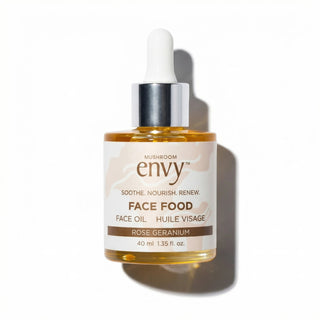
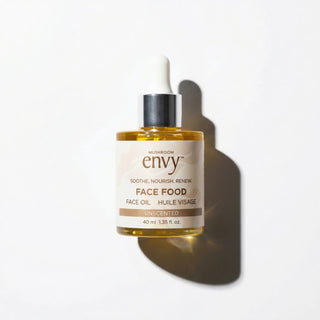
That is a big part of why our Face Food is built the way it is. The ingredients in order are sunflower seed oil, rosehip seed oil, jojoba seed oil, cranberry seed oil, calendula flower oil, vitamin E, shiitake extract and reishi extract. If you want to know more about the second one, we covered it in Rosehip Oil for Your Face: What Is Actually in It?
A simple way to use one: press two or three drops into skin that is still a little damp from washing, morning or night. The skin feels softer straight away and looks less flat by the afternoon.
To be clear about what the evidence says: the Kwag study measured sebum in women of different ages. It tested no product, so it cannot tell us what Face Food or any other oil does to sebum levels. What it gives us is a better question to ask.
What does this study not tell us?
Quite a lot, so here are the edges.
It is cross sectional. That means it compared different women of different ages at one point in time, not the same women followed over years.
It measured the skin surface only. It did not look at deeper layers of skin.
The authors suggest menopause may explain why the change speeds up around 40, but they did not test hormones. For now that is an open question.
And it was funded by Human Skin Clinical Trial Center Co., Ltd., a company that runs skin testing. That does not make the numbers wrong, but you should know it.
We are a two person team in Victoria, BC, my son Ryan and me, and you can read how Mushroom Envy started. We would rather share a study like this with its limits showing than oversell it.
Frequently asked questions
Does skin produce less oil after 40?
For women, on average, yes. In a study of 7,743 women in 12 countries, skin surface oil fell faster from age 40, and at 50 to 59 it was 34.9% lower in Asian women and 25.4% lower in Western women than at 20 to 29.
Does older skin lose more water?
Not in that study. Surface hydration differed by less than 3.5% between age groups, and resting water loss through the skin went down with age rather than up.
Should I stop using my hydrating serum?
No. If you like how it feels, keep it. The numbers simply suggest that adding more water may not fix tightness if what has dropped is oil.
Is face oil the same as sebum?
No. Sebum is a mix of triglycerides, wax esters and squalene made by your own skin. A plant oil is a different blend that sits on the same surface and can make skin feel softer.
If you want to try a face oil, Face Food comes in Rose Geranium or Unscented.