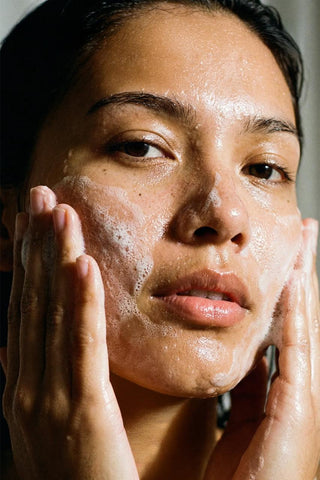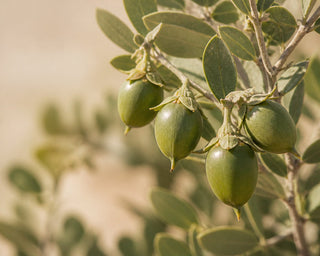
Jojoba oil suits most faces, and the reason it feels so different from other oils is that it is not really an oil at all. About 98 percent of it is a liquid wax made of wax esters, a family of lipids your own skin also makes. That is why it feels light, sinks in without a greasy film and stays fresh longer than most plant oils.
I am Angele, and jojoba is the third ingredient in every bottle of Face Food. You may have heard that jojoba "is just like your skin's own oil." That line is half true. Here is the half that holds up, the half that does not, and what the research actually measured.
Why is jojoba oil not really an oil?
Most plant oils, like sunflower, olive and rosehip, are triglycerides: three fatty acids hooked onto a glycerol backbone. Jojoba is built differently. A 2021 review of jojoba chemistry puts its wax content at about 98 percent, mainly wax esters, with only a few triglycerides, free fatty acids and sterols making up the rest (Gad et al., 2021).
A wax ester is one long fatty acid joined to one long fatty alcohol. In a solid form you would know it as candle or beeswax. Jojoba's version just happens to stay liquid at room temperature, which is why it pours like an oil and gets sold as one.
You can feel the difference. Rub a drop of olive oil and a drop of jojoba on the backs of your two hands. The olive oil sits there and stays shiny. The jojoba spreads thin and disappears faster, leaving skin soft rather than slick.
Is jojoba oil like the oil your skin makes?
Partly. Your skin's own oil, called sebum, is a mix of several lipids. A review of sebaceous gland lipids explains that human sebum contains two that are found nowhere else in the body: squalene and wax esters (Picardo et al., 2009). So jojoba and sebum do share a type of molecule, and that is where the "just like your skin" line comes from.
Here is the half that does not hold up. Wax esters are only one part of sebum, alongside triglycerides, squalene and free fatty acids, and the exact wax esters in jojoba are not the same ones your glands make. Jojoba is a close cousin of one ingredient in your skin's oil. It does not copy the whole thing. I would rather tell you that than repeat a nice sounding claim.
Sebum also changes as we get older. We looked at new research on that in does skin get drier with age?, and it is one reason a light face oil often feels better on skin past forty than it did at twenty.
Does jojoba oil go rancid?
Much more slowly than most plant oils. Oils go rancid when oxygen attacks their fatty acids, and the more polyunsaturated fat an oil holds, the faster that happens. Because jojoba is mostly wax esters with very little polyunsaturated fat, it has less to lose.
A 2026 study compared four oils, three of which happen to be in Face Food: rosehip, sunflower, olive and jojoba. The researchers heated each one to 100 °C and timed how long it held out before oxidizing quickly. Jojoba lasted the longest, then olive, then sunflower, with rosehip the shortest, and the ranking lined up with how much polyunsaturated fat each oil contained (Fagoaga et al., 2026).
That was a heat test in a lab, not a bottle sitting in your bathroom cabinet, so it does not tell you how many months any oil lasts at home. What it does show is the order. Rosehip is the light, fast absorbing oil people love, and also the most fragile. We wrote about what is in it in rosehip oil for your face. Jojoba sits at the steady end of the same scale.
Does jojoba help other skincare ingredients sink in?
Maybe, but the evidence is early. In a 2023 pilot study, researchers added 10 percent jojoba to a cream containing retinol and tested it on an artificial membrane designed to imitate the outer layer of skin. With jojoba in the mix, about 40 times more retinol made it through the membrane in 16 hours than without it (Gruber et al., 2023).
Three things to keep in mind. It was a synthetic membrane, not human skin. It was a small pilot. And the authors work for a company that supplies jojoba to cosmetic makers. It is an interesting result that needs testing on real people before anyone builds a promise on it. Face Food contains no retinol, so we mention it only because it comes up in almost every article about jojoba, and you deserve to know how thin it is.
How do you use jojoba oil on your face?
The same way you would use any face oil. After cleansing, while your skin is still a little damp, warm three or four drops between your palms and press them onto your face and neck. Damp skin helps a small amount of oil spread further, which we explain in face oil vs. moisturizer.
- Start with three drops at night, then add a morning application if your skin likes it.
- Try a new oil on a small patch of your jaw for a few days before using it all over.
- Buy it cold pressed and golden. Clear jojoba has usually been refined, which strips out some of what makes it interesting.
- Close the cap after every use. Jojoba is steady, but no oil enjoys light, heat and air.
Why is jojoba in Face Food?
A plain bottle of good jojoba from a health food store is a perfectly decent face oil on its own, and I will happily say so. We blend it because each oil brings something different. Face Food is, in order: sunflower seed oil, rosehip seed oil, jojoba seed oil, cranberry seed oil, calendula flower oil, vitamin E, shiitake extract and reishi extract, with rose geranium added to the Rose Geranium version. Everything is organic except the vitamin E and the essential oil.
Sunflower and rosehip give the blend its light, quick feel. Jojoba brings the soft, silky finish and is the steadiest of the three oils. The mushrooms are the reason we started; you can read how that began in our story.
If you prefer no added scent, Face Food Unscented has the same jojoba and the same blend, just without the rose geranium.
Frequently asked questions
Is jojoba oil an oil or a wax?
It is a liquid wax. About 98 percent of jojoba is wax esters, which is why it feels lighter than most plant oils even though it is sold as an oil.
Does jojoba oil go bad?
Very slowly. It holds up to oxidation better than rosehip, sunflower or olive oil, but keep it capped and away from heat and sunlight, and stop using it if it smells sharp or stale.
Can I use jojoba oil on my face every day?
Most people can use three or four drops once or twice a day. Try it on a small patch first, and use less if your skin looks shiny an hour later.
Is there jojoba in Face Food?
Yes. Organic jojoba seed oil is the third ingredient in both Face Food Rose Geranium and Face Food Unscented.