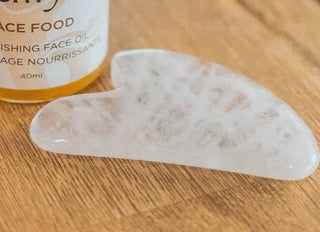
Gua sha (say it "gwah-shah") is a simple ritual: a smooth, flat stone glided slowly over oiled skin. It has roots in traditional Chinese practice, where a much firmer scraping technique was used on the body. The facial version is gentle, closer to a slow massage. Here's how to do it well, and what it can and can't do.
What gua sha does
Done gently and regularly, facial gua sha can help your face look and feel better in a few specific ways:
- It can help reduce the look of puffiness, especially first thing in the morning.
- Your face can look more awake and radiant after a session.
- Your jaw, brow and forehead feel more relaxed.
- It helps your face oil spread evenly and absorb, so a few drops go further.
We'll be honest about the limits. Research on facial gua sha is limited, and the studies that exist are small. What it does is what you can see in the mirror and feel under your hands, and those effects are temporary, so a regular routine matters more than any single session. No stone will change your skin overnight.
Prep with Face Food oil
A gua sha stone should glide, never drag. On dry skin it tugs, which is why oil always comes first.
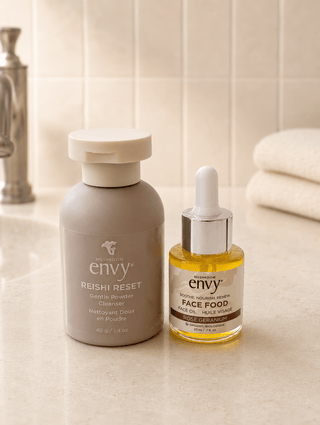
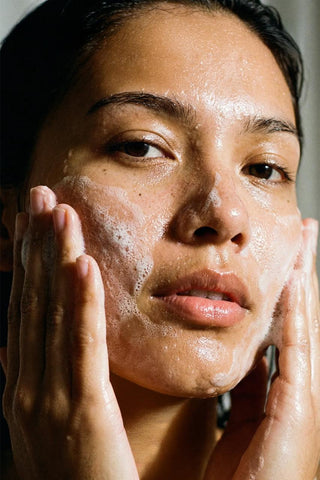
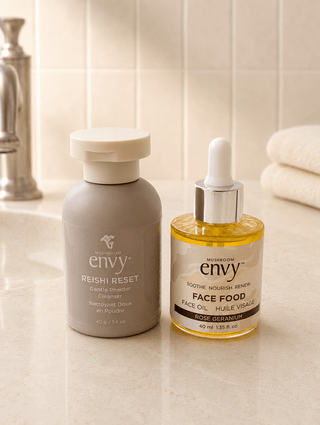
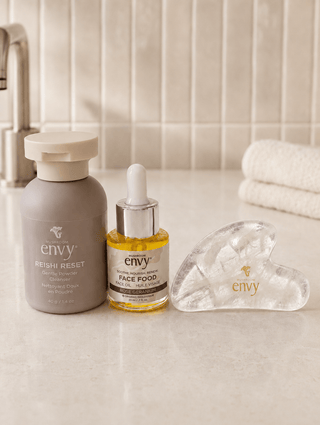
- Start with clean skin. We use Reishi Reset, our gentle powder cleanser, then pat the skin mostly dry.
- Warm 3 to 4 drops of Face Food between your palms and press it over your face and neck.
- If the stone catches partway through, add another drop or two.
Face Food blends organic reishi and shiitake mushroom extracts with rosehip, jojoba and calendula oils, made in small batches in Victoria, BC. It's light and non-greasy, with enough slip for the stone to move smoothly. If you're sensitive to fragrance, Face Food Unscented works the same way.
Choosing your stone
We offer two stones: white quartz and tiger eye. Both are used exactly the same way. White quartz feels cool and clean against the skin; tiger eye has warm amber-brown banding. Pick the one you'll enjoy reaching for, because that's what keeps a ritual going.
Stroke-by-stroke technique
Three rules before you start:
- Hold the stone nearly flat against your skin, not upright on its edge.
- Use light pressure, about as much as you'd use to spread lotion. This is not a deep-tissue tool.
- Stroke in one direction, upward and outward, then lift and return to the start. Repeat each stroke 3 to 5 times, then switch sides.
Then work from the bottom of your face up:
- Neck. Glide from the base of your neck up to your jawline, front and sides. Go especially light over the front of your throat.
- Jawline. Start at your chin and follow the jawbone out to just below your ear, using the curved edge of the stone.
- Cheeks. Start beside your nose and sweep across the cheekbone toward your temple.
- Under the eyes. With the lightest touch of the whole routine, glide from the inner corner out toward the temple. The skin here is thin, so one or two passes is enough.
- Brows. From the centre of your brow, glide out along the brow bone to the temple.
- Forehead. From your brows up to the hairline, working from the centre outward.
Finish by resting the flat of the stone on each temple for one slow breath, then press any leftover oil into your skin with your palms.
Watch the technique
Prefer to follow along? Here's the routine on video.
How often
Start with 1 to 2 sessions a week, morning or night, and build up to a daily routine once you know how your skin responds. A full-face session takes about 3 to 5 minutes.
Morning sessions are good for helping your face look less puffy and more awake before the day starts. Evening sessions are more about winding down before bed.
Consistency matters more than intensity: a few light minutes most days beats one long, heavy-handed session a week.
Mistakes to avoid
- Pressing too hard. Facial gua sha should never hurt or leave marks. If your skin stays red after a session, lighten up.
- Working on dry skin. Without enough oil the stone tugs. Add a drop whenever it catches.
- Scrubbing back and forth. Glide in one direction, lift, and start again.
- Working over skin that needs a break. Skip any area with active breakouts, broken skin or sunburn, and skip gua sha altogether if your skin flushes easily. If you're unsure, check with your doctor or dermatologist first.
- Skipping cleanup. Wash the stone after every use (see the FAQ below).
FAQ
Does facial gua sha actually work?
It depends on what you expect. Many people find their skin looks less puffy and more awake after a session, and that their face feels more relaxed. Research on facial gua sha is limited and the studies are small, so we don't promise more than that. The effects you can see are temporary, which is why regular practice matters.
Should gua sha hurt or leave red marks?
No. Facial gua sha uses light pressure and should feel soothing. Your skin may look slightly pink for a few minutes, but it shouldn't hurt or stay red. If it does, use less pressure and more oil.
Can I use a gua sha stone without oil?
We don't recommend it. On dry skin the stone drags and tugs. A few drops of a face oil like Face Food give the stone enough slip to glide, and the strokes help the oil spread evenly and absorb.
How do I clean my gua sha stone?
Wash it with warm water and a mild soap after every use, rinse well, and let it dry completely before putting it away. Store it where it won't get dropped, since natural stone can chip or crack.