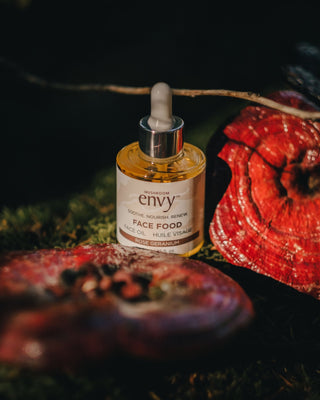
Mushroom skincare means topical products, such as oils, cleansers and creams, made with extracts of functional mushrooms like reishi and shiitake. What those extracts bring is two families of compounds: beta glucans, which hold water at the surface of the skin, and antioxidants such as ergothioneine. The honest version is that the lab evidence is real and the evidence on actual faces is still thin, and we think you should know which is which.
First, the most common confusion: no, it’s not that kind of mushroom. Mushroom skincare has nothing to do with psychedelics or dispensaries. That mix up is real. When we checked our own Search Console numbers, roughly 46% of the searches that showed this site were people looking for a dispensary. Reishi and shiitake are the same mushrooms you’d find in a wellness latte or a stir fry, applied to the skin, not eaten.
What is actually inside a mushroom that matters for skin?
Two things do most of the work in the research.
Beta glucans. These are long chains of glucose that make up a large part of a mushroom’s cell wall. Oats and yeast have them too. Pulled out with water, they behave like a light film that holds moisture at the surface of the skin, which is why cosmetic chemists have used them for decades. A review in Phytotherapy Research covers their moisturizing and film forming behaviour in detail.
Antioxidants. Mushrooms are one of the richest natural sources of ergothioneine, an unusual sulphur containing amino acid that plants and animals cannot make for themselves. Reishi adds its own group of compounds called triterpenes, the reason a reishi tea tastes so bitter.
What does reishi do for skin?
Reishi (Ganoderma) has been used in East Asian herbal tradition for roughly two thousand years. Here is something most brands won’t tell you: DNA work over the last fifteen years found that most of the “Ganoderma lucidum” sold in Asia is actually a different species, now called Ganoderma sichuanense or lingzhi. It is the name you will see on our ingredient lists, and the more accurate name for the mushroom people have always meant.
In the lab, reishi extracts show strong antioxidant activity. A 2017 study in Food and Chemical Toxicology made an ethanol extract, identified the triterpenes and phenolic acids doing the work, and showed they kept their activity once mixed into a cream. A study published this year in the International Journal of Cosmetic Science measured a reishi extract inhibiting tyrosinase, the enzyme behind visible pigment, by about 30% in a test tube, and found it was gentler on skin cells than two common cosmetic actives it was compared against.
Notice the words “in the lab” and “in a test tube”. Those are cell and chemistry studies. We could not find a controlled trial of reishi on its own on human faces. That doesn’t make it useless. It means the honest claim is about how skin looks and feels when reishi is part of a good formula, not a promise about what one mushroom does.
What does shiitake do for skin?
Shiitake (Lentinula edodes) is the antioxidant half of the pair, and the compound to know is ergothioneine. Dried shiitake carries about 1 mg of it per gram, according to a 2023 analysis in the Journal of Food Composition and Analysis; across species, Penn State researchers measured anywhere from 0.15 to 7.27 mg per gram, with oyster mushrooms usually ahead of shiitake.
The interesting part for skin is that ergothioneine can’t just drift into a cell. It needs a dedicated transporter, OCTN1. A 2009 study in Free Radical Biology and Medicine found that the keratinocytes in the top layer of skin make that transporter, take ergothioneine in, and in cell culture under simulated sunlight showed less oxidative damage. Skin cells, in other words, seem built to use it. That is a dish, not a face, and it is no substitute for sunscreen.
You will often read that shiitake “contains kojic acid”, the well known brightening ingredient. We looked, and we could not find a single study showing it. Kojic acid is made by Aspergillus moulds, the ones used to brew sake and soy sauce, and that is how it is produced commercially. We used to repeat the shiitake line ourselves. We’ve stopped.
Is mushroom skincare good for sensitive skin?
It is a sensible family of ingredients for it, with a caveat. Beta glucans and mushroom antioxidants are mild and rarely irritate, which is why they show up in formulas for sensitive skin. The best human study we found is a useful reality check. In a 2018 double blind trial, 20 people with sensitive skin used a cream containing beta glucan and hyaluronic acid sourced from mushrooms on one side of the face for 28 days. Hydration and smoothness improved clearly. But the plain control cream on the other side did just as well.
That is the position we’ll defend: for sensitive skin, a gentle formula used every day matters more than any single headline ingredient, mushroom or otherwise. What mushrooms give you is a way to get antioxidants and moisture into a short ingredient list without reaching for harsher actives. It is also why we make an unscented Face Food: for reactive skin, leaving out fragrance often matters more than anything you add.
Does it matter whether the mushroom is in an oil or a cleanser?
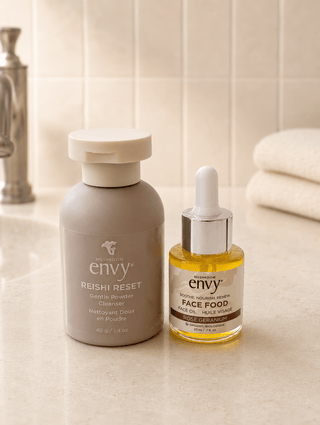
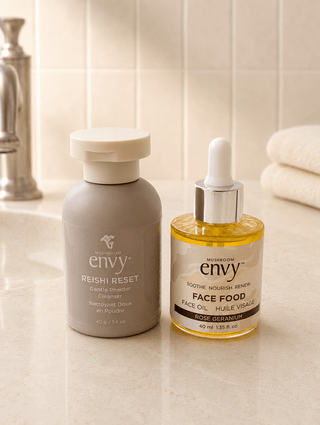
More than most labels admit. Beta glucans and ergothioneine dissolve in water, not oil, while reishi’s triterpenes lean toward oil and alcohol. So the format shapes which compounds can do their job. In a powder cleanser like Reishi Reset, the reishi is whole ground mushroom that meets water in your palm. In a face oil, the oil’s main job is to slow water loss, which is why it works best pressed into damp skin. There is more on that in Face Oil vs. Moisturizer.
How do you build a mushroom skincare routine?
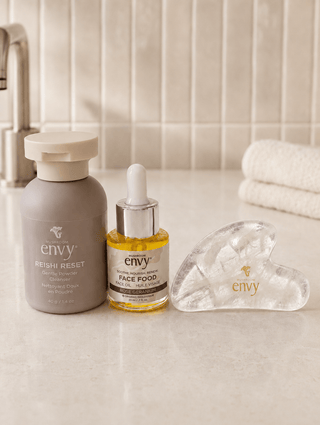
Keep it short. Cleanse with something that doesn’t leave your face tight, then press a few drops of oil into damp skin. A gua sha afterwards is optional and nice. That is the whole ritual, and the order matters more than the brand.
Angele started Mushroom Envy at her kitchen counter in Victoria, BC, and you can read how it began here. If you’d like to test a mushroom face oil before committing, the $9 Face Food Mini is the full formula in 3 ml.
Frequently asked questions
Is mushroom skincare the same as eating mushrooms?
No. Mushroom skincare uses topical extracts of functional mushrooms like reishi and shiitake. It is not psychedelic, and it is not something you ingest.
Do mushroom extracts hydrate skin?
The beta glucans in mushrooms hold water at the surface of the skin and form a light film, which helps skin feel more hydrated. They do this in water based formulas. In an oil, the hydration comes from sealing in water that is already there.
Does shiitake contain kojic acid?
We could not find any study showing it does. Kojic acid is produced by Aspergillus moulds. Shiitake’s standout compound is the antioxidant ergothioneine.
Is there clinical research on mushroom skincare?
Most of it is lab and cell research. Human trials on mushroom ingredients alone are rare and small, so treat bold promises with caution and judge a product by how your skin looks and feels after a few weeks.